 I am Shreya and I was 14 years old when I was diagnosed with Adolescent Idiopathic Scoliosis (AIS) where scoliosis develops without any known cause. My parents noticed abnormal shape of my back with spine curving to one side and it has progressed from barely noticeable to severe within a span of three months since it was first noticed.
I thought I was born normal. I grew up thinking I was same as everyone. I never thought that something would change my life drastically as scoliosis. The first x-ray of my spine left me completely broken.
 Bracing was not an option given the magnitude of my curve angle of 750. Before operation I had one week of traction through a ring around my head and weights attached to hospital bed and this was told that this will increases the flexibility of the curve and help achieve more correction at time of surgery. After one week of traction I underwent uneventful scoliosis correction surgery because of careful pre-operative planning, meticulous surgical technique, use of available modern techniques and real time spinal cord monitoring (Intra Operative Neuro Monitoring (IONM)) which are part of safe spine surgery protocols of Dr.Muralidharan’s daily practice.
I was in the hospital for 5 days. I was about three inch taller and shape of my back was perfect post surgery. At 1 month post-surgery I started going to school classes. I resumed all my sports, swimming and dance activities at 3 months post surgery.
I’m proud of the scar on my back. Enduring traction and spinal fusion surgery helped me develop a depth of character that has convinced me that I can do anything that I set my mind to.
Really felt happy and surprised to see the 100% result after surgery.
Be strong and positive. I was happy that I could get through this.
 I was in the hospital for 5 days. I was about three inch taller and shape of my back was perfect post surgery. At 1 month post-surgery I started going to school classes. I resumed all my sports, swimming and dance activities at 3 months post surgery.
I’m proud of the scar on my back. Enduring traction and spinal fusion surgery helped me develop a depth of character that has convinced me that I can do anything that I set my mind to.
Really felt happy and surprised to see the 100% result after surgery.
Be strong and positive. I was happy that I could get through this.
 I’m proud of the scar on my back. Enduring traction and spinal fusion surgery helped me develop a depth of character that has convinced me that I can do anything that I set my mind to.
Really felt happy and surprised to see the 100% result after surgery.
Be strong and positive. I was happy that I could get through this.
 I am Towfiq 23 years old from Dhaka in Bangladesh, I was born with a rare condition called arthrogryposis multiplex congenita. This is a rare birth condition where the joints are extremely stiff and contracted. Up until the age of 11, though I was stunted by the bent joints, I was normal in terms of weight and other indicators. However, at the age of 11, I suddenly began losing weight and lost most of my muscle mass. The result was that my arms and legs began to appear like just a layer of skin covering bone.
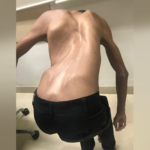 Despite all these troubles, I managed to carry on my life and get an education, even entering college. However, in the last six years, my spine had become bent, leaving my torso twisted to the left.
At age 23, I weighed just 27 kg because my bent spine was pushing into my stomach and preventing me from eating properly. My lungs were under similar pressure, making breathing a difficult job. And because the bend was so severe that my ribs were rubbing against his pelvis was in constant, debilitating pain.
I met Dr Muralidharan in 2018 and got all the trust and confidence in the first meeting itself to choose him as my surgeon. He told me that because of my bent limbs, bent knees and bent hips, my body was forced to be in an awkward position for me to maintain balance when I stood and hence, my spine became twisted to allow me to maintain my centre of gravity.
A comprehensive set of blood, genetic, neurological, lung function and cardiological tests followed. The primary concern for Dr Muralidharan was to assess whether my body could withstand such a major surgical procedure. Also my earlier episode of muscle mass loss was a key concern too, as losing muscle mass after the surgery would lead to further complications. So I had to undergo genetic screening and muscle biopsies to look for whether there were any signs of known muscular dystrophy.
Though all the tests were promising, Dr Muralidharan said that his other colleagues were skeptical of the possibilities of success, raising the risks of wound infections, wound breakdown and paralysis. All of the risks and possibilities were placed before me and my family when I was counseled before opting for the surgery. Ultimately, I chose to go ahead with the procedure despite the risks, as I desperately sought relief from the pain that haunted me constantly.
 Dr Muralidharan, openly said that my case is real challenge. Even with a normal flexible curve, they only aim to correct 60%-70% that some residual curvature remains which is acceptable. But in my case Dr Muralidharan felt that if we manage around 40%-50% correction that is more than enough.
Even before the surgery could take place, I had to undergo intensive treatments as a first step. For two weeks, I was placed under halo-gravity traction, where a metal ring is placed around the head and attached via pulley to weights, so that the spine is gradually stretched. I was also prescribed breathing exercises to improve my lung function, and was given protein supplements in my diet to build up his protein levels before the surgery.
On day of surgery I know the procedure itself involved complications at every step due to multiple challenges in my case. I was wheeled into surgery at 8am and it took 3 hours just to set me positioned for the surgery and the neuro-monitoring, which would keep track of any possibilities of neurological damage during the procedure. Similarly, a special kind of anaesthesia had to be used so that the neuro-monitoring was not interrupted. And the dosage had to be carefully calibrated because of my extreme underweight.
Positioning me on operation table during the surgery was crucial because they had to be cautious so they don’t stretch or break my already flexed, contracted joints, and that my pressure points were protected.
 The procedure itself lasted for six hours and I was told that first they released tight soft tissues around the spine. Then, the vertebral joints around the spinal curve had to be meticulously broken to allow it to be flexible enough for realignment. Finally, using screws and a rod contoured to the desired shape, my spine was fixed in its new alignment.
In the end, my surgery turned out to be a marvelous success. I spent one day in the ICU for observation. By the second day, I was up and about. By the fifth day, I was out of the hospital, and by the tenth day, I had returned home to Daka.
I recently came back for a follow-up and I am very happy with the shape of my back and all of my pain has gone. I am also breathing much more comfortably. I have gained 3kg since the surgery, and am able to eat more frequently and eat better. I have happily returned to my college life.
Thanks a ton to Dr Muralidharan and his team.
 Mahek is 13 years aged girl from West Bengal. She is special child born with develeopmental defects affecting several parts of the body. She congenital kyphosis where there is exaggerateround back of the upper spine (hunchback). She also had heart repair at 1 year age. She has permanent tracheostomy (opening in the neck for breathing) and she cannot vocalise much. She has global developmental delay and weighs 20 kgs.
Normally Mahek enjoys walking and she started having difficulty in walking and became wheelchair dependent because of severe progressive kyphotic spine and spinal cord compression.
Mahek parents consulted several surgeons across country and almost last hope of daughter walking again as was left with the impression that surgery not worth to take risk and nothing to gain.
 Mahek parents met Dr Muralidharan in 2019 and got all the trust and confidence in the first meeting itself to have Mahek’s surgical journey under his care. Dr Muralidharan explained all challenges starting from evaluation, optimisation, tracheostomy care, intra operative and post-operative issues.
Initially she had halo gravity traction for two weeks to stetch the spine and this was done as day care set up as she is phobic to hospitals.
Her surgery was uneventful and Mahek is now mobile on her feet without assistance.
